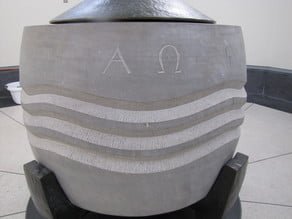
Written by Catherine Casserly, based on parish records and documents and interviews with parishioners.
Former pastor and liturgist, Father Corbin Eddy has proposed that a true church has three parts. First, it must be orthodox: that is, be in line with liturgical traditions. Secondly, it must be involved with the wider world through social justice. Thirdly, it must be beautiful in order to reflect God’s absolute beauty. In its sixty years’ journey, St. Basil’s has become a true church. The following story does not give a chronological history but tells of some of the events and people that shaped the parish.
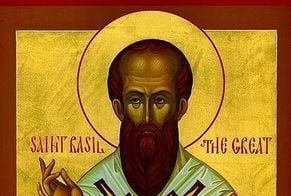
Saint Basil the Great was born in 329 in Caesarea of Cappadocia (present day Turkey), to a family renowned for their learning and holiness. His mother, Emily, and his grandmother, Macrina, are Saints of the Church, together with all his brothers and sisters: Macrina, Gregory of Nyssa, Peter of Sebastia, and Naucratius. Basil studied in Constantinople then in Athens, where also he formed a friendship with Gregory, a fellow Cappadocian, later called "the Theologian." Through the influence of his sister Macrina, he embraced the ascetical life and abandoned his worldly career. He visited the monks in Egypt, Palestine, Syria, and Mesopotamia, and when he returned to Caesarea, he went to a hermitage on the Iris River in Pontus, not far from Annesi, where his mother and his sister were already living ascetical lives. Here he wrote his ascetical homilies which were meant to help the faithful to more perfectly follow Christ and attain Christian perfection through self-discipline. He was a spiritual monastic who taught the importance of community and balance; a bishop who shepherded faithfully through treacherous controversies; a liturgist and scholarly theologian who contributed to the marriage of Christianity and classical culture in his time. The influence of St. Basil the Great remains among the best of Catholic tradition.
The Congregation of St. Basil was established in France as a teaching order. They chose St. Basil the Great, a fourth century teacher, bishop and doctor of the Church, to be the namesake of the new community that they came to serve. Their time in Ottawa spanned the period of 1958 to 1992 – 34 years of service to the parish and community. This is recognized in the parish mission statement which states the parish is rich in a heritage built by laity and Basilians. The priests who taught at St. Joseph’s High School on Broadview Ave. were very much involved in parish life.
Vocations from the parish
Rev. Brian Swords was ordained as a priest in the Scarboro Foreign Missionaries in 1968 and served for many years in China. He is currently Moderator of his order.
Rev. Donald McLeod, CSB, was ordained at St. Basil’s in 1978.
Archbishop Michael Miller, CSB, was from St. George’s parish, but as a student at St. Joseph’s High School, he considered St. Basil’s as his second parish home.
The Beginning
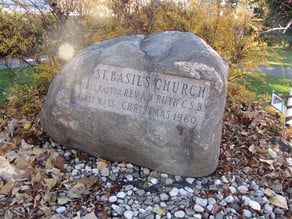
In the mid 1950’s, housing subdivisions began to spring up in the Ottawa West area and the population exploded. In response, in 1955, the new parish of St. Andrew Corsini was announced by Archbishop Lemieux. It was to be operated by the Order of Carmelites who were also to run a new Catholic high school. Because the Carmelites were unable to become accredited to teach in Canada, they withdrew and were replaced by the teaching order of the Congregation of St. Basil, more commonly known as Basilians. The Basilians insisted that the parish be renamed after their patron saint. That change took place on January 18, 1958.
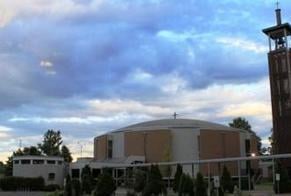
For the first two years, the parish met on Sundays at Nepean High School. In 1958, it moved to the gymnasium of St. Joseph’s High School. On Christmas Eve., 1960, the first Mass was celebrated in the new round church.
Parish Philosophy Was Established Early
A key step in determining the kind of parish St. Basil’s would become was the establishment in 1959 of a chapter of the Christian Family Movement (CFM) whose motto was Observe, Judge, Act. Couples came together in small cells to study Scripture and try to figure how it could be applied to their own lives and demands. The approach was one that they integrated into every facet of their lives. One of their first major activities was the sponsorship of a refugee family and facilitating their integration into Canadian life. Together, each cell pondered many questions. One was the role of women in the church. It marked the beginning of a profound change to begin to share leadership with the lay people.
The questions the cells discussed were not easy ones. One major topic was the issue of birth control. These couples were the parents of rapidly expanding families. Once, Father John Kelly, then assistant pastor, was at a meeting of the cell as the chaplain, a role in which the priests were supposed to remain silent unless asked. But he could not take the challenge to the Church’s beliefs. He stormed out and when he got to the Rectory, Father Ruth asked him what he was doing back so soon. Father Kelly told him the problem. “Well,” said Father Ruth, “I guess that you better turn around and go back and talk with the people and not at the people.”
The CFM was to have a profound impact on couples and individuals, and it contributed directly to the social activism for which St. Basil’s developed a well-deserved reputation.